Boards Approve Pension Funding Policy
The Boards of Directors of the San Joaquin Hills Transportation Corridor Agency (SJHTCA) and the Foothill/Eastern Transportation Corridor Agency (F/ETCA) have approved the establishment of a Pension Funding Policy aimed at proactively addressing future pension liabilities. The policy reflects fiscal responsibility in managing pension obligations and strategically addresses the Transportation Corridor Agencies’ (TCA) pension plan’s unfunded actuarial accrued liability (UAAL), if one were to exist in the future. TCA provides its full-time employees with a defined pension plan through the Orange County Employee Retirement System (OCERS) which is funded by employee and employer contributions.
In 2019, the Boards of Directors authorized the payoff of the Agencies’ UAAL, providing a present value savings of approximately $2.5 million. Since that action, TCA has not incurred an additional UAAL.
This action aligns with the Boards’ Strategic Plan and reflects the Agencies’ ongoing commitment to maintaining financial flexibility, supporting strategic initiatives, and upholding best practices in governance.
Comprehensive Systemwide Traffic Study to Support Strategic Planning
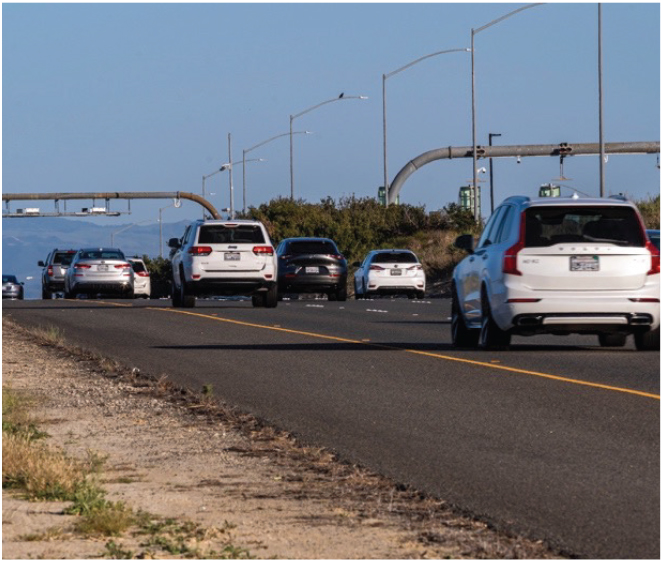 The Boards approved a task order with Jacobs Engineering Group Inc. to conduct a comprehensive Systemwide Traffic Study (STS) to inform the timing of future capital improvement projects, support long-range planning for The Toll Roads, and inform staff engagement with local, regional, and state partners. This study is generally done every five to seven years, with the last study completed in 2020.
The STS will evaluate current and projected traffic conditions across The Toll Roads network, which includes State Routes 73, 133, 241, and 261. The study will also include the development of a traffic microsimulation model to assess future operational conditions and guide the timing of TCA’s Capital Improvement Program (CIP) projects.
This effort reflects the Boards’ commitment to data-driven decision-making and strategic investment in infrastructure. The overarching goal is to identify potential operational and capacity enhancements that will preserve free-flow travel and ensure the continued reliability of The Toll Roads.
TCA Staff Presents Concepts Received for Reuse of Toll Plazas
As part of the Boards’ approved Strategic Plan, TCA staff were charged with evaluating innovative reuse opportunities for underutilized toll plazas, staff issued a Request for Information (RFI) to gather ideas that could benefit local communities. While three proposals were received and reviewed in coordination with the California Department of Transportation (Caltrans), none were deemed feasible at this time, due to current jurisdictional and design constraints. Concepts received, such as Electric Vehicle (EV) charging stations, could be implemented under certain requirements and may become more viable in the future should legislative barriers be reduced or policy
changes occur at the state level.
Additional concepts received outside the RFI process are also under consideration. These include a potential Caltrans maintenance station at the Tomato Springs Toll Plaza and continued coordination with the Orange County Fire Authority (OCFA) to explore fire-mitigation opportunities at TCA sites where it would be beneficial to the community. Staff will continue coordinating with Caltrans, OCFA, and other stakeholders to evaluate future proposals and maintain an open channel for new ideas via the Agencies’ website.
Boards Approve Pacifica Building Joint Ownership Transaction
With future building improvements approved by the Boards of Directors earlier this year, SJHTCA and F/ETCA agreed to the sale of a 50 percent share of the 125 Pacifica Building, headquarters for the TCA, operators of The Toll Roads, from F/ETCA to SJHTCA. The purchase allows the Agencies to share equally in the cost of the Pacifica Building remodel project, all future building improvements, utilities, and maintenance, while also sharing equally in the residual value of the building if it were to be sold. Since 1999, SJHTCA has leased space from F/ETCA while sharing costs of common staff and operating the customer service center. These costs will continue to be shared between both Agencies as TCA processes transactions for the San Bernardino County Transportation Authority (SBCTA) and future tolling agency partners.
Chief Executive Officer Report
CTC Public Hearing Demonstrates Strong Support for TCA’s Tolling Authority Request for the 241/91 Express Connector Project
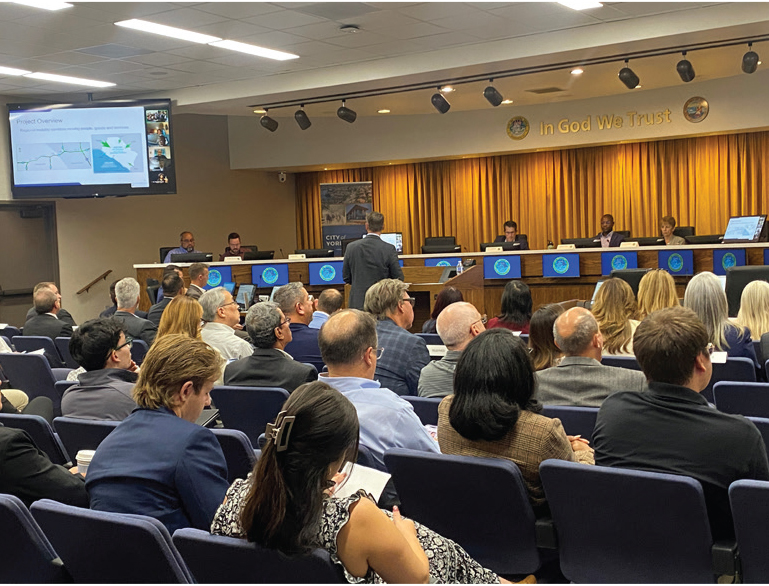 CEO Ryan Chamberlain provided the Boards with an update on the California Transportation Commission (CTC) public hearing held on October 1, 2025, regarding the 241/91 Express Connector project. The hearing, a required step for agencies seeking tolling authority under AB 194, was well attended and marked by strong local and regional support, with no opposition. TCA received enthusiastic endorsements from transportation partners, including Orange County Transportation Authority (OCTA), Riverside County Transportation Commission (RCTC), and Caltrans, as well as numerous letters of support from elected officials, business and government organizations, chambers of commerce, and labor representatives.
CTC Commissioners heard a comprehensive overview of the project, including its benefits and operational details. The next step in the process is for the application for supplemental tolling authority to be considered at an upcoming CTC meeting in December. CEO Chamberlain expressed appreciation to the F/ETCA Board of Directors and TCA staff, along with local partners, for their collaboration and continued support in advancing this critical regional transportation project.
Toll Processing Partnership with Capital Area Regional Toll Authority Moves Forward
 At its Board of Director’s October 15 board meeting, CEO Chamberlain shared that the Capital Area Regional Toll Authority (CARTA) unanimously approved the selection of TCA as CARTA’s preferred back-office and customer service partner, directing CARTA staff to engage with TCA in cost negotiations and contract development.
Similar to TCA’s toll processing partnership with SBCTA, the partnership for account management and payment processing services will improve efficiencies in processing transactions and reduce costs to both TCA and CARTA by sharing back-office systems.
